

DPM is the only MEP-specific solution redefining command and control.
Vision like never before.
Stop using tech built for a GC on custom homes. The new standard for MEP PMs.
Documint PM is an AI building intelligence platform for real estate, oil and gas, data centers, commissioning, and maintenance and operations. Powered by TIA (Trade Intelligence Assistant) — advanced scheduling, progress tracking, robotics integration, local AI, and on-site persistent intelligence. TIA catches drift before it becomes an expensive impact, cites its sources, and proposes recovery plans with the math on the table. Built by a licensed plumber and 28-year MEP project manager. Runs on your existing tech stack — no rip and replace.
Talk into the chat. On your phone. Through Bluetooth. While driving.
Update on scope 1020A. Any drift alerts? Hours used, hours remaining, and when's the next billing?
Need a layout crew for a UG job. Which projects can spare one based on crew metrics? Who can I pull? Find a win — don't hand me a loss. The move has to improve margin on both jobs.
Weekly owner update. Cost, schedule, top three risks. Read like it's from me — not a bot.
Sanity check. New APM on Project 1020A starting Monday. What's drifting? Who does he need to meet first? Where are the traps?
Every source cited. Every data gap named. When TIA's confidence is 55%, you see that number before she gives you an answer.
Nothing gets saved without your approval.
Built for Project Executives, Owners & Superintendents
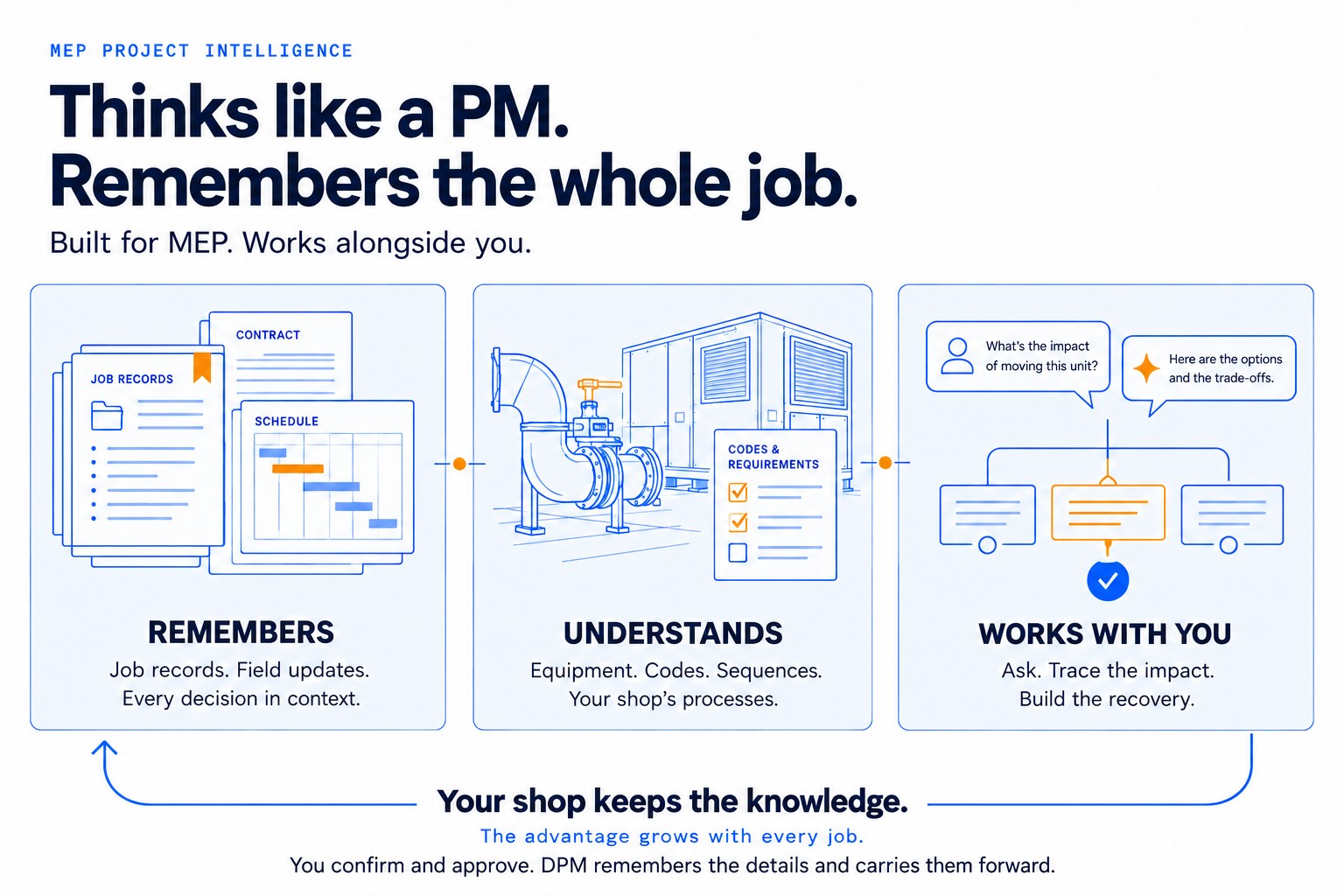
Your project holds millions of decisions and data points. The best PM can hold 4 to 7 at a time. DPM holds the rest.
End cost and schedule impacts.
Your team is always in control. Connects to your existing systems, doesn't replace them.
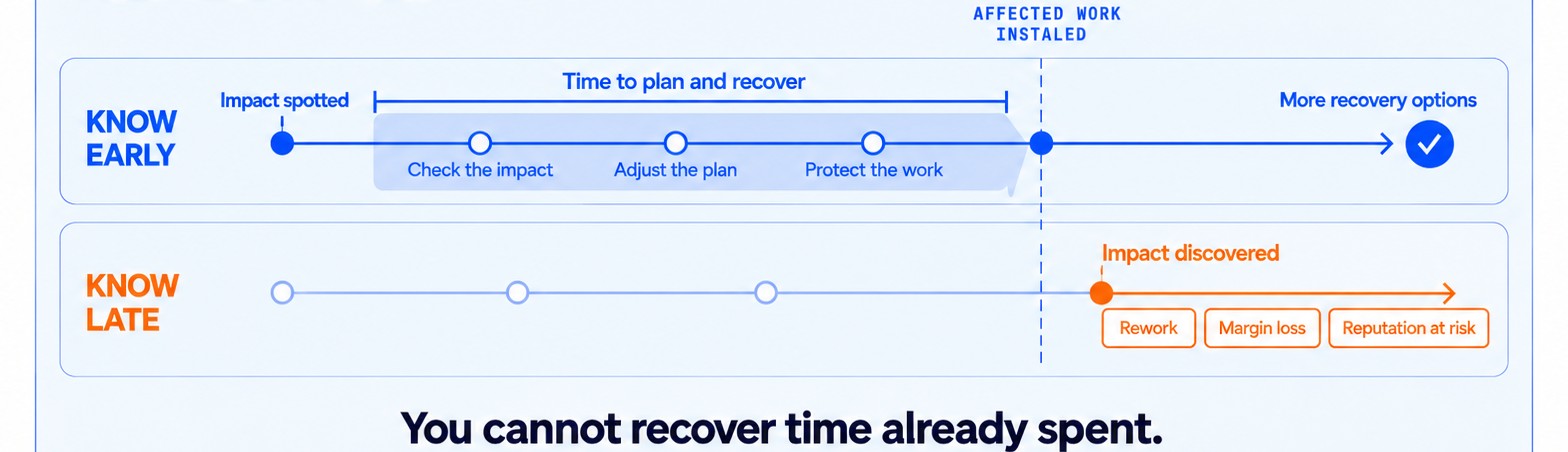
DPM watches your job in real time. It catches cost and schedule impacts early and updates your schedule. It runs 24/7, 365 days a year, always searching. When it finds an impact, you get an alert. Then DPM runs simulations to find the best path forward, to grow your margin or get you back to the margin you booked in the estimate.
Always on. Always protected.
Built by construction professionals with decades of experience managing mission critical builds, DPM works alongside your existing systems to improve visibility, project controls, and decision-making.
Most project teams don't lack information, talent, or grit. If you're on a big project, you're one of the best in the industry. Start using tech that matches your skill.
Critical project data lives across project management platforms, schedules, procurement systems, emails, field reports, and the conversations in between. DPM brings those disconnected sources together into a single operational view, so teams can see what's happening and where attention is needed.
DPM connects your existing dashboards and systems into searchable intelligence that identifies and predicts cost and schedule impacts.
It also generates production schedules across every horizon:
Working with your PM and live project data, DPM runs multi-scenario testing to determine the best path forward, then generates all the construction documents your shop uses.
Every project plan changes. The difference between successful and struggling projects is how quickly teams identify and respond to those changes.
DPM helps construction teams quickly detect:
Instead of learning about problems weeks later, project teams gain visibility while corrective action is still possible.
Instead of replacing the systems your team already relies on, DPM connects project information across schedules, documents, project management platforms, procurement systems, field reports, and communication channels.
Instead of hunting for answers in multiple tools, teams can quickly understand what's happening, identify emerging risks, and make more informed decisions.
We built DPM to be versatile. It connects with the tech you already use and empowers your PM to multiply their productivity while reducing their workload.
DPM continuously analyzes project information to help teams understand what is happening, why it matters, and where intervention may be required.
By connecting schedules, contracts, field activity, procurement, and cost data, DPM solves the information problem, so project managers spend less time searching and more time leading projects.
DPM studies your team's wins and losses to sharpen your estimates and operations.
The new standard in MEP.
Most platforms rent you access while your project data trains a shared model that serves everyone, including your competitors. DPM keeps your shop's intelligence where it belongs: under your roof, under your control.
DPM is a hybrid by design. It runs on local models on-site when your project calls for it, and draws on multiple frontier models the rest of the time. You get the best available intelligence without locking your data, or your project, to any single provider.
A dedicated model trained on your projects, your language, your standards, not a rented, shared instance serving your competitors.
On-prem or private cloud. Your project data never leaves your infrastructure, and it is never used to train shared models.
You control what the model can see, who it serves, and how it learns. Guardrails built by construction people, not Silicon Valley.
Stop renting. Keep your shop's intelligence in-house.
DPM wasn't developed in a software incubator in Silicon Valley. The platform was built from decades of real-world, lived experience solving communication failures, workflow breakdowns, schedule impacts, and operational challenges across active construction projects.
For nearly 30 years, Documint PM Founder & CEO Matthew Smith has been a licensed Journeyman Plumber and MEP PM. He has worked across every aspect of plumbing and mission-critical infrastructure projects, obsessed with keeping field teams on point, safe, and in work, and projects on time and on budget.
Soon after GPT was released to the public, Matthew downloaded it in the offices of Trident Mechanical. He has been putting it to work on real projects ever since. His goal was simple: stop cost and schedule impacts, and deliver for the field crews and the owners who carry the risk of running the work. Today he has deep, hands-on experience with how GPT, Claude, and local open-source models actually behave, and with the logic, code, and services needed to maintain high-quality, active construction solutions. He ran projects by day and coded deep into the morning, turning the failures he and his teams lived through into working solutions. DPM isn't built from chat rooms or interviews; it's a quarter-century-plus failure library, turned into software that stops cost and schedule impacts before they hit.
Matthew coded the first three versions of DPM himself, roughly 1,200 hours of work. Then he made a decision: the next version needed to be built by professionals.
He brought on a team of software developers to build the front and back end, AI/ML PhDs and engineers with master's degrees, AWS certifications, and computer science degrees. People with real experience solving deep, intricate, logic-based problems. Over the last 12 months, the team has been building and testing.
Matthew has not touched the code in over a year. He still prototypes and builds new functions, but the professionals take it from there.
Models handle only a small portion of what DPM does. Logic, code, and sophisticated services are what deliver our solution.
The team saw something early: frontier LLM providers will eventually restrict access to their models. We also did not want our customers' proprietary data traveling across networks where it could be used to train someone else's model. So we built a system that does not depend on either.
DPM can run entirely on-site: models, compute, and storage, with redundant Wi-Fi and on-site power generation. If an LLM provider goes down, your job stays live.
Watch DPM connect project information, catch emerging issues, and turn data into action in under 30 seconds.
We need this. This is the future.
I'm jealous I didn't build this.
We're putting DPM to work on a six-month tenant-improvement build in South Carolina.
DPM would have caught a misalignment between revised plan sheets on a large underground section, the one that cost us a three-week, thirteen-man install working seven days a week.
We're currently partnering with a select group of MEP contractors to validate results on active projects.
Rather than asking teams to replace existing software, DPM runs alongside current workflows to identify opportunities for improved project controls, risk detection, and operational efficiency.
Construction project management software helps contractors organize schedules, budgets, documentation, communication, and project workflows throughout the lifecycle of a construction project.
DPM helps construction teams analyze large amounts of project information, identify risks earlier, improve forecasting, and reduce the time spent searching for critical information.
Yes. DPM functions as construction project controls software by helping teams monitor schedule performance, cost impacts, productivity, procurement, and project risk across active jobs.
Unlike traditional project controls tools that focus primarily on reporting, DPM continuously analyzes information from contracts, schedules, field activity, procurement systems, and project documentation to identify emerging issues and help teams take action before cost and schedule impacts occur.
DPM does not replace Procore. DPM connects to your existing tech, it doesn't replace it, pulling information from the systems your team already relies on and transforming it into actionable intelligence.
DPM analyzes schedules, contracts, field updates, procurement information, and project documentation to identify emerging cost and schedule impacts before they become larger project issues.